A field manual for FrontWars
Rails: laid, not built
Rails are not a building. A factory lays them, and they exist to carry trains that pay on every visit. This page is what the client states about them and what it does not.
- TESTEDthe rail and train lines, read in the client, 2026-11-03
- IN-GAMEthe automatic rail-laying and fixed train payout, quoted
- OFFICIAL ONLYno store page describes rail mechanics
- NEEDS CHECKwhether train payout scales with city level
You do not place track
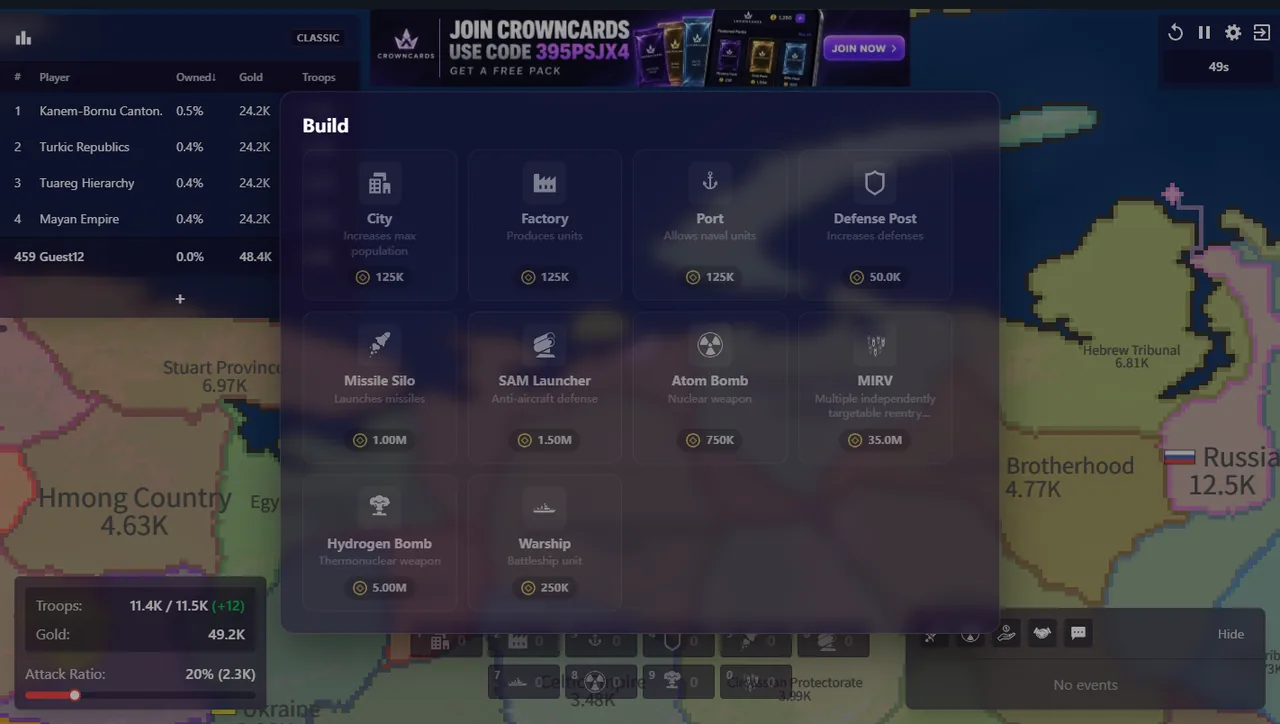
There is no rail slot in the build bar. The Instructions screen states that a factory automatically lays railroads toward nearby cities, ports and factories, and that the line may connect to friendly neighbours' buildings. Your job is placing the factory; the geometry follows.
What a train pays
The same screen says a train pays fixed gold for each building it visits, with a bonus for buildings belonging to a friendly neighbour. "Fixed" is the loaded word: it rules out a scaled payout, and a competing wiki's tier table (50,000 at level 3, 100,000 at level 5, 300,000 at level 10, by its own labels) is the kind of claim that needs a session, not a quote.
We have not run that session. This page prints the client's word and says the tier table is unverified rather than adopting it.
Why a line survives longer than a factory
Rails pay per visit, so the value of a line is the number of buildings still standing on it, multiplied by how often a train runs. A line that crosses a contested border is a line that stops paying the moment the border moves. That is the argument for putting the factory behind the front and pointing the rails inward instead of at the enemy.
The three things we still want to measure
- The payout of a single train visit, in gold, at a known city count.
- Whether that payout changes when a city is upgraded.
- Whether a train run can be interrupted, and what a destroyed building does to a line's payout.
Until those are measured, the honest summary is the client's own sentence plus the build order: factory at 125,000, placed where the rails reach two other buildings, behind the line rather than on it. That is a placement rule, not a number, and placement is the part this page can prove today.
Last checked against the client: 2026-11-03 · client v42.5